Material origin and scientific context
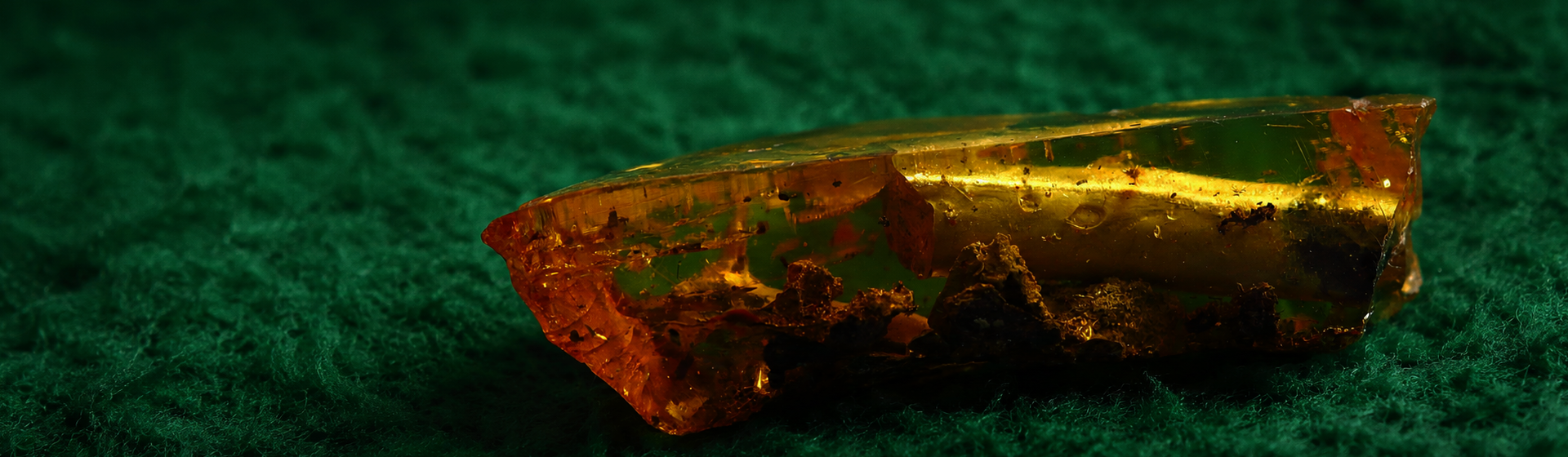
Large Raw Amber Origin from Western Ukraine
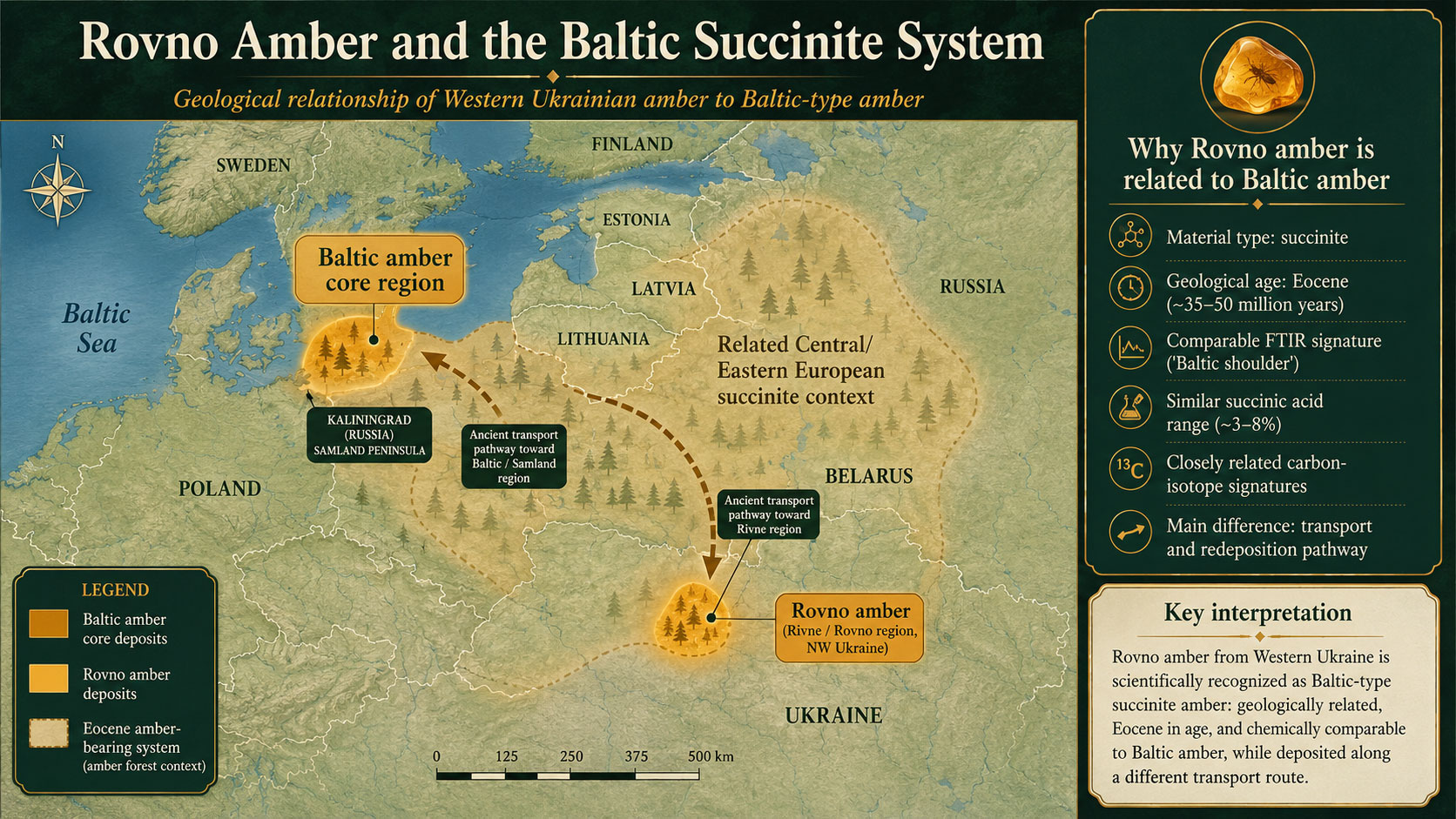
Western Ukrainian amber from the Rivne / Rovno geological region is genuine succinite and belongs to the same Central / Eastern European amber context commonly associated with Baltic-type amber.
Is Western Ukrainian amber comparable to Baltic amber?
Yes. Ukrainian amber, especially amber from north-western Ukraine, has the same origin as Baltic amber.
Scientifically, amber from the Rivne / Rovno region, commonly referred to as Rovno amber, is genuine succinite. It shares the decisive material characteristics of Baltic Sea amber.
Geological similarities
- Same geological age: Both deposits date back to the Eocene epoch and are approximately 35 to 50 million years old.
- Same botanical source: Both were formed from the fossilised resin of the prehistoric conifer commonly referred to as Pinus succinifera.
- Same ancient forest system: At the time of formation, a vast connected primeval forest existed across large parts of Northern and Eastern Europe, often described as the Fennoscandian amber forest.
The difference lies in the transport route
The real difference is not the material type, but the way the amber reached its present-day deposits:
- Baltic amber was transported by ancient rivers and marine currents towards the region of today’s Baltic Sea and Samland.
- Ukrainian amber was transported southwards by currents and Ice Age glacial processes into the river delta areas of today’s deposits. It is now found mainly in sandy sedimentary layers in north-western Ukraine.
For this reason, Ukrainian amber may sometimes show a slightly thicker weathering crust or local colour nuances. Chemically and biologically, however, it is directly related to Baltic amber.
Scientific evidence for the material identity
To demonstrate that Ukrainian amber from the Rivne / Rovno region and Baltic amber from the Baltic Sea area are identical in terms of material type, mineralogy and geochemistry use clear and reproducible laboratory methods.
Both are classified as the same amber type: succinite.
1. Spectroscopic fingerprint - FTIR analysis
The standard method for identifying amber is infrared spectroscopy, commonly referred to as FTIR analysis.
The evidence: When infrared light passes through Baltic amber, its chemical structure produces a specific spectral curve known as the “Baltic shoulder”.
The result: Ukrainian amber shows the same characteristic curve and the same absorption bands in FTIR analysis. Spectroscopically, the molecular bonds of both materials are not distinguishable from each other.
2. Chemical composition - succinic acid content
Genuine succinite is characterised by a high proportion of bound succinic acid, which distinguishes it from many other fossil resins such as copal or Dominican amber.
The evidence: Both Baltic amber and Ukrainian amber show the same basic chemical structure.
The result: Both types consist of approximately 79% carbon, 10.5% hydrogen and 10.5% oxygen. The decisive succinic acid content lies within the same range of approximately 3% to 8% in both deposits.
3. Geochemical isotope signature - δ13C
Modern geochemical studies measure the carbon isotope signature, δ13C, to determine geological age and botanical origin.
The evidence: δ13C values are directly linked to the CO2 composition of the atmosphere in which the original resin-producing trees grew.
The result: Ukrainian amber has a measured δ13C value of -23.3 ± 0.9‰. This value matches the values known for Baltic amber. This provides chemical evidence that both resins were produced during the same Eocene period, approximately 35 to 50 million years ago, by the same botanical source group.
Precision note
While the material type, succinite, is chemically equivalent, recent highly sensitive hydrogen isotope measurements, δ2H, indicate that the resins may have entered the ground at different geographic locations before being transported and redeposited over millions of years.
Amber formation origin proof
Scientific article: Distinct origins for Rovno and Baltic ambers: Evidence from carbon and hydrogen stable isotopes. PALAEO Journal Vol. 505
Illustrative geological infographic for visual reference only. This digitally generated image is intended for explanatory use and is not an official geological survey map.